A textile shop near Cherpulassery Road used to plan a print campaign two months in advance, waiting on a printer’s schedule and a fixed release date. AI and digital marketing have compressed that timeline into days, sometimes hours, because software now handles targeting, testing, and adjustment work that once took a full team. The shift raises a real question for marketers and shop owners alike. Does traditional digital marketing still hold value, or has automation quietly taken over the job?
This piece looks at where AI genuinely changes outcomes, where older methods still carry weight, and how the two fit together in practice.
AI and Digital Marketing: What Does Actually Change?
Generative tools now draft a week’s worth of social captions in the time it used to take to write one. Predictive models forecast which ad budget split will perform before a rupee gets spent, rather than after a campaign has already run its course. That shift from reacting to forecasting is the single biggest change AI brought to the field. Students enrolled in an AI-integrated digital marketing course in Pattambi now spend their early weeks learning prompt structuring and tool stacks that a marketer working five years ago never had to touch.
None of this replaces strategy. A tool can generate ten headline variants in seconds, but someone still has to decide which one matches the brand’s voice and which audience segment actually needs to see it.
Traditional Digital Marketing: What Still Works
SEO fundamentals have not changed as much as the tools built around them. Keyword research, site structure, page speed, and backlink quality still decide whether a page ranks. What has changed is how fast a marketer can research and act on those fundamentals.
Community trust also resists automation. A local business that responds personally to a Google review, or a marketing manager who understands the specific concerns of buyers in Palakkad, brings judgment that a model cannot fully replicate. Email newsletters written with a consistent, recognizable voice still outperform generic AI-drafted blasts, largely because readers notice the difference even when they cannot name it.

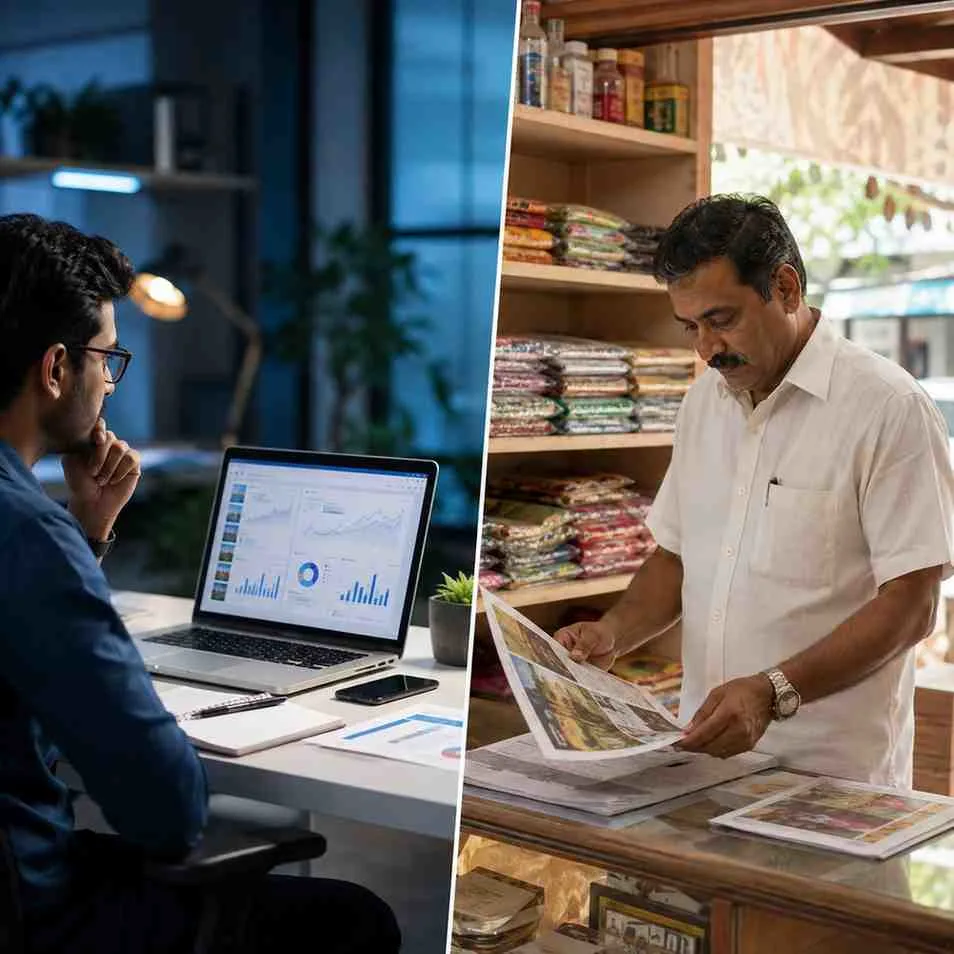
Speed, Data, and Personalization: The Practical Difference
Ad spend is where the gap shows up first. A campaign running ₹500 a day used to get reviewed once a week, if that, by whoever had time to open the Ads Manager dashboard. By the time anyone noticed a keyword group was bleeding money, four or five days of spend were already gone. Predictive tools now catch that same drop within hours and shift the budget toward whichever ad set is actually converting.
That doesn’t make the human role smaller. It just moves it. A marketer who used to spend Monday mornings pulling last week’s numbers now spends that time on creative direction, client calls, or figuring out why one ad angle resonates with buyers in Palakkad and another falls flat. The monitoring got automated. The judgment calls did not.
Personalization tells a similar story, though it started from a rougher place. Traditional segmentation sorted people into a handful of broad buckets, something like “women, 25 to 40, urban.” AI-driven targeting works closer to the individual level now, adjusting a message based on what someone browsed an hour ago or whether they tend to shop late at night versus on a lunch break. The bucket approach isn’t gone. It’s just the starting point rather than the finished strategy.
Choosing the Right Approach for Pattambi Businesses and Job Seekers
For a business owner, the practical answer is rarely either/or. AI tools cut the time spent on research, drafting, and budget tracking. Traditional marketing knowledge still shapes what gets said and why it resonates with a specific local audience. Blending both is where most working marketers actually land.
For someone building a career, the training gap matters more than the philosophical debate. SilverHost Digital Academy, the educational wing of an agency with 18 years of market experience, structures its training around this blend, pairing core SEO, content, and ad fundamentals with the AI tools now expected in agency work. That combination reflects what most Kerala-based and Gulf-facing agencies are actually hiring for right now, rather than one skill set in isolation.
Final Thoughts
The honest answer is that AI and digital marketing did not replace the traditional playbook. It sped up the parts that used to take the longest and left the parts that require judgment, taste, and local knowledge mostly untouched. Which of those two skill sets do you think your own business or career is missing right now?
FAQ
Is AI actually replacing digital marketers, or is it just changing the job?
Mostly the second one. AI handles repetitive work like drafting variants or tracking ad spend, but campaign strategy, brand voice, and client judgment still need a person. Marketers who learn the tools tend to move faster, not get replaced by them.
Do I need to know coding to work with AI marketing tools?
No. Most AI marketing tools, from content generators to ad optimization platforms, are built with simple interfaces. What matters more is understanding prompts, data patterns, and how to judge whether an output is actually good.
What's the real difference between AI SEO and regular SEO?
Regular SEO still relies on the same core signals: keywords, site structure, and backlinks. AI SEO adds tools that speed up research, spot patterns in ranking data, and suggest content gaps faster than manual analysis ever could.
Should a small business in Palakkad bother with AI ads if the budget is tight?
Often more so than a bigger budget would need. When there’s only ₹300 or ₹500 a day to work with, every wasted rupee stings, and predictive tools catch underperforming ads faster than a person checking the dashboard once a week ever could. Tight budgets tend to gain the most from that kind of real-time correction.
How long does it take to get comfortable with AI-integrated marketing tools?
Basic comfort usually comes within a few weeks of regular use. Deeper skill, the kind that lets someone judge good output from mediocre output, tends to build over a few months of hands-on campaign work.